Current
Electrons move at a walking pace; it is the push that is instant.
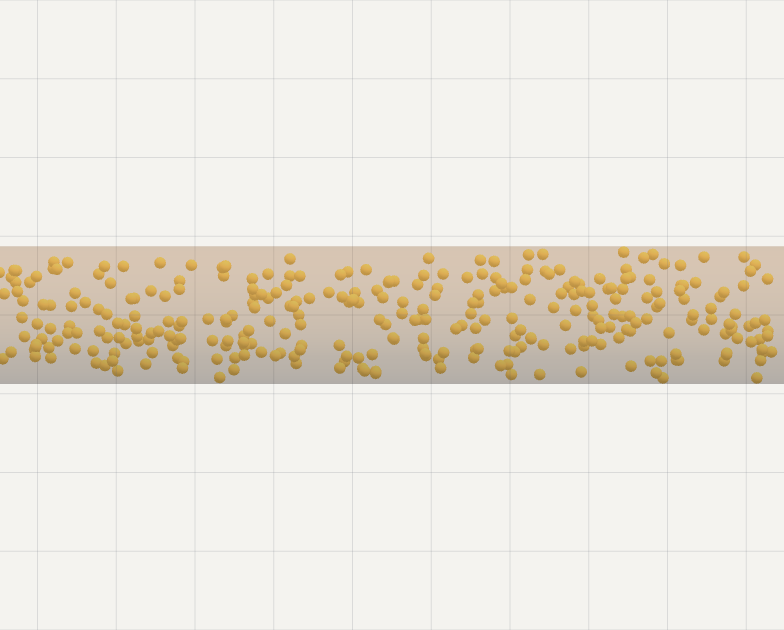
Electrons move at a walking pace; it is the push that is instant. In a copper wire, every atom has let go of one electron that wanders freely: there are about 8.34 × 10²⁸ m⁻³ of them, an unimaginable crowd. Apply a voltage and the whole crowd drifts the same way, but slowly: in a household wire, barely 0.45 mm/s, slower than a snail. The light still comes on at once, because the push travels from one end to the other at nearly the speed of light, like a hose already full of water. Current, measured in amperes, is nothing more than the number of charges crossing a point every second. Raise the voltage: the crowd speeds up and the counter races. Thicken the wire: more electrons get through at once.
Sources
- ≈ 8.34 × 10²⁸ m⁻³ University Physics Volume 2, 9.2 Model of Conduction in Metals, OpenStax, retrieved 11 October 2026.
- ≈ 0.45 mm/s University Physics Volume 2, 9.2 Model of Conduction in Metals, OpenStax, retrieved 11 October 2026.