Resistance and heat
Your phone warms up because electrons jostle atoms.
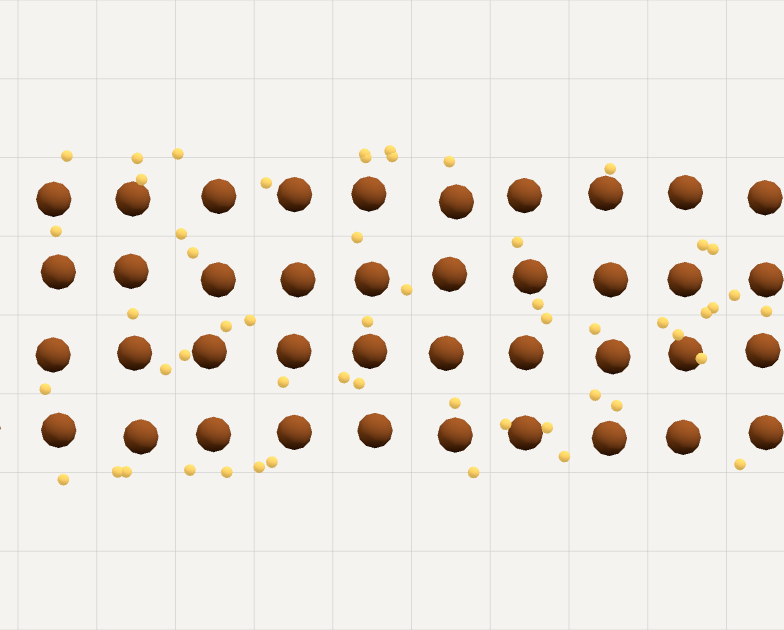
Your phone warms up because electrons jostle atoms: every collision is heat. Drifting through the wire, electrons keep bumping into the lattice of copper atoms, which start to vibrate harder; that vibration is temperature. This hindrance is called resistance, and copper has very little of it, 1.68 × 10⁻⁸ Ω·m of resistivity, which makes it the wire of almost everything. Glass, at the other end, has 1,000,000,000 to 10,000,000,000,000 Ω·m: billions of billions of times more, because it has almost no free electron to offer. When you charge fast, a lot of current crosses traces and a cell that resist a little, and the phone warms in your hand. The same phenomenon, pushed to the limit, is what makes a toaster's wire glow red. Raise the current and watch the thermometer; cut it, and the lattice settles down.
Sources
- ≈ 1.68 × 10⁻⁸ Ω·m Table of Resistivity (at 20 °C), HyperPhysics, Georgia State University, retrieved 11 October 2026.
- 1,000,000,000 to 10,000,000,000,000 Ω·m Table of Resistivity (at 20 °C), HyperPhysics, Georgia State University, retrieved 11 October 2026.