Inside the cell
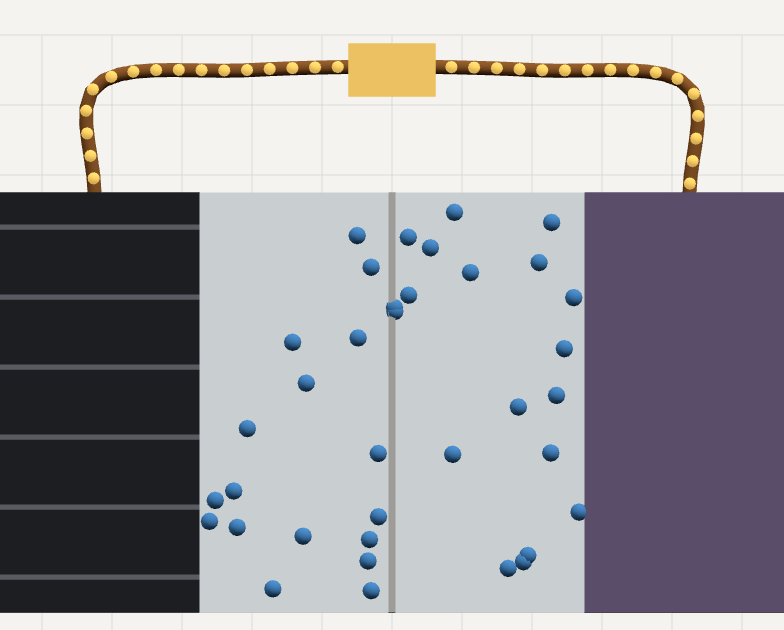
Ions go through the inside; electrons are forced around the outside.
Ions go through the inside; electrons are forced around the outside, and that detour is what powers the phone. Two electrodes face each other: layered graphite on one side, a lithium cobalt oxide on the other, separated by a porous membrane soaked in liquid. Charged, the cell has parked its lithium atoms between the graphite's sheets, where they would rather not stay. On discharge, each one drops an electron and crosses the membrane as an ion, to settle in the oxide where it is more comfortable. The electron cannot cross: it leaves through the wire, passes through the processor and the screen, and meets its ion on the other side. Charging means forcing the reverse trip with a stronger voltage, up to 4.2 V per cell. Cobalt holds the oxide's structure together while lithium comes and goes; that is why it is mined, and its thread will open later.
Sources
- 4.2 V BU-303: Confusion with Voltages, Battery University, retrieved 11 October 2026.