Charge
Everything rests on two signs that attract or repel.
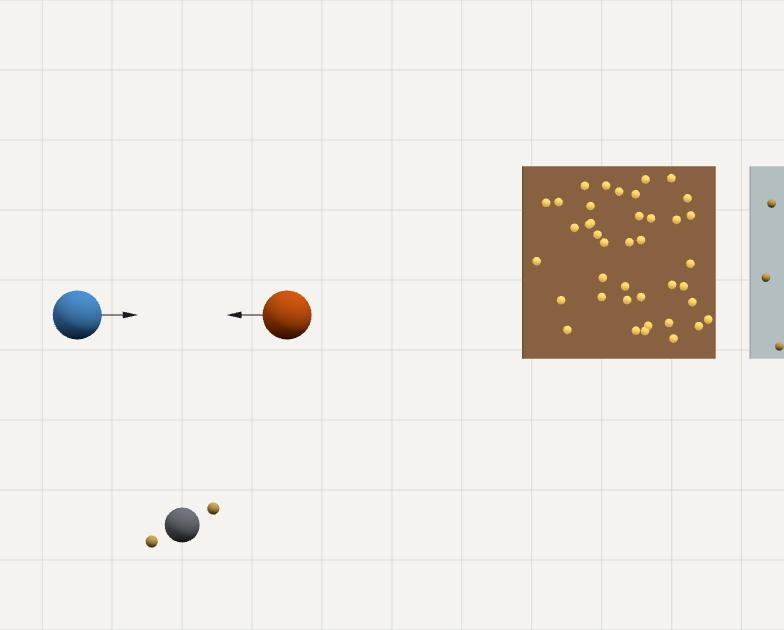
Everything rests on two signs that attract or repel; copper conducts because its electrons are free. Charge is a property of matter, like mass, but it comes in two signs: the proton carries plus, the electron minus, and each exactly 1.602 × 10⁻¹⁹ C, not a bit more. Two charges of the same sign repel, two opposite charges attract, and the force fades fast with distance: double the gap and it drops to a quarter. An atom has as many protons as electrons, it is neutral, and that is why ordinary matter does not stick to our fingers. In copper, the outermost electron of every atom is held by nobody and forms a sea that flows at the slightest push: it is a conductor. In glass, every electron stays glued to its atom: it is an insulator. In between sits silicon, which conducts only when asked; that is the semiconductor path, and it is coming.
Sources
- 1.602 × 10⁻¹⁹ C CODATA Value: elementary charge, NIST (CODATA 2022), retrieved 11 October 2026.